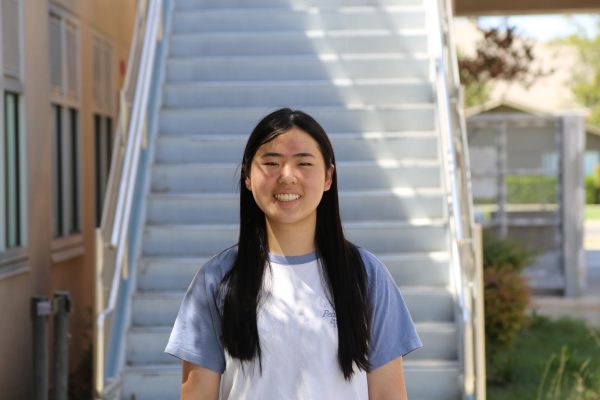

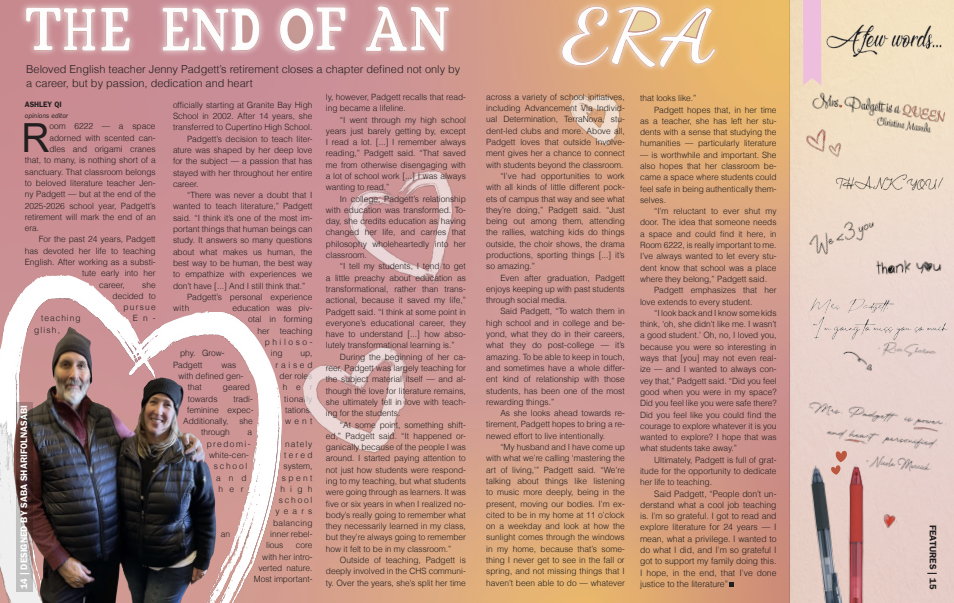
Room 6222 — a space adorned with scented candles and origami cranes that, to many, is nothing short of a sanctuary. That classroom belongs to beloved literature teacher Jenny Padgett — but at the end of the 2025-2026 school year, Padgett’s retirement will mark the end of an era.
For the past 24 years, Padgett has devoted her life to teaching English. After working as a substitute early into her career, she decided to pursue teaching English, officially starting at Granite Bay High School in 2002. After 14 years, she transferred to Cupertino High School.
Padgett’s decision to teach literature was shaped by her deep love for the subject — a passion that has stayed with her throughout her entire career.
“There was never a doubt that I wanted to teach literature,” Padgett said. “I think it’s one of the most important things that human beings can study. It answers so many questions about what makes us human, the best way to be human, the best way to empathize with experiences we don’t have […] And I still think that.”
Padgett’s personal experience with education was pivotal in forming her teaching philosophy. Growing up, Padgett was raised with defined gender roles that geared her towards traditionally feminine expectations. Additionally, she went through a predominately white-centered school system, and spent her high school years balancing an inner rebellious core with her introverted nature. Most importantly, however, Padgett recalls that reading became a lifeline.
“I went through my high school years just barely getting by, except I read a lot. […] I remember always reading,” Padgett said. “That saved me from otherwise disengaging with a lot of school work […] I was always wanting to read.”
In college, Padgett’s relationship with education was transformed. Today, she credits education as having changed her life, and carries that philosophy wholeheartedly into her classroom.
“I tell my students, I tend to get a little preachy about education as transformational, rather than transactional, because it saved my life,” Padgett said. “I think at some point in everyone’s educational career, they have to understand […] how absolutely transformation learning is.”
During the beginning of her career, Padgett was largely teaching for the subject material itself — and although the love for literature remains, she ultimately fell in love with teaching for the students.
“At some point, something shifted,” Padgett said. “It happened organically because of the people I was around. I started paying attention to not just how students were responding to my teaching, but what students were going through as learners. It was five or six years in when I realized nobody’s really going to remember what they necessarily learned in my class, but they’re always going to remember how it felt to be in my classroom.”
Outside of teaching, Padgett is deeply involved in the CHS community. Over the years, she’s split her time across a variety of school initiatives, including Advancement Via Individual Determination, TerraNova, student-led clubs and more. Above all, Padgett loves that outside involvement gives her a chance to connect with students beyond the classroom.
“I’ve had opportunities to work with all kinds of little different pockets of campus that way and see what they’re doing,” Padgett said. “Just being out among them, attending the rallies, watching kids do things outside, the choir shows, the drama productions, sporting things […] it’s so amazing.”
Even after graduation, Padgett enjoys keeping up with past students through social media.
Said Padgett, “To watch them in high school and in college and beyond, what they do in their careers, what they do post-college — it’s amazing. To be able to keep in touch, and sometimes have a whole different kind of relationship with those students, has been one of the most rewarding things.”
As she looks ahead towards retirement, Padgett hopes to bring a renewed effort to live intentionally.
“My husband and I have come up with what we’re calling ‘mastering the art of living,’” Padgett said. “We’re talking about things like listening to music more deeply, being in the present, moving our bodies. I’m excited to be in my home at 11 o’clock on a weekday and look at how the sunlight comes through the windows in my home, because that’s something I never get to see in the fall or spring, and not missing things that I haven’t been able to do — whatever that looks like.”
Padgett hopes that, in her time as a teacher, she’s left her students with a sense that studying the humanities — particularly literature — is worthwhile and important. She also hopes that her classroom became a space where students could feel safe in being authentically themselves.
“I’m reluctant to ever shut my door. The idea that someone needs a space and could find it here, in Room 6222, is really important to me. I’ve always wanted to let every student know that school was a place where they belong,” Padgett said.
Padgett further emphasizes that her love extends to each and every student she’s had.
“I look back and I know some kids think, ‘oh, she didn’t like me. I wasn’t a good student.’ Oh, no, I loved you, because you were so interesting in ways that [you] may not even realize — and I wanted to always convey that,” Padgett said. “Did you feel good when you were in my space? Did you feel like you were safe there? Did you feel like you could find the courage to explore whatever it is you wanted to explore? I hope that was what students take away.”
Ultimately, Padgett is full of gratitude for the opportunity to dedicate her life to teaching.
Said Padgett, “People don’t understand what a cool job teaching is. I’m so grateful. I got to read and explore literature for 24 years — I mean, what a privilege. I wanted to do what I did, and I’m so grateful I got to support my family doing this. I hope, in the end, that I’ve done justice to the literature.”