Upholding academic integrity has always been a top priority for teachers. In the past, plagiarism detection tools helped them identify cases of dishonesty. However, with the rise of artificial intelligence technology, teachers now face a more difficult task: identifying unoriginal work created by generative AI.
For over 20 years, Turnitin has been the main academic integrity tool used by teachers in the Fremont Union High School District. In the past, Turnitin solely functioned as a plagiarism detection software — comparing students’ submitted work with sources on the internet and other works entered into its database.
However, as AI has become more prominent over the years, the use of AI in the classroom has become a significant problem. A 2023 survey of 1,316 high school students found that 58% reported using generative AI for schoolwork. In response to the significant surge in AI use, Turnitin launched its AI detection feature in April 2023, shortly after the debut of ChatGPT by OpenAI. AI usage has only continued to increase since then — by 2025, around 84% of high school students reported using it for schoolwork.
For both students and teachers, AI detection tools serve as a form of protection against unverified accusations. A reliable AI detection system can help teachers identify AI content more accurately and provide evidence for teachers when addressing potential academic dishonesty concerns with students or parents.
Zach Jacobs, who has taught English at Cupertino High School for 19 years, said, “It sparks a conversation. It makes it much less of an ‘I’m accusing you of something,’ and much more of a ‘Let’s see if we can figure this out.’”
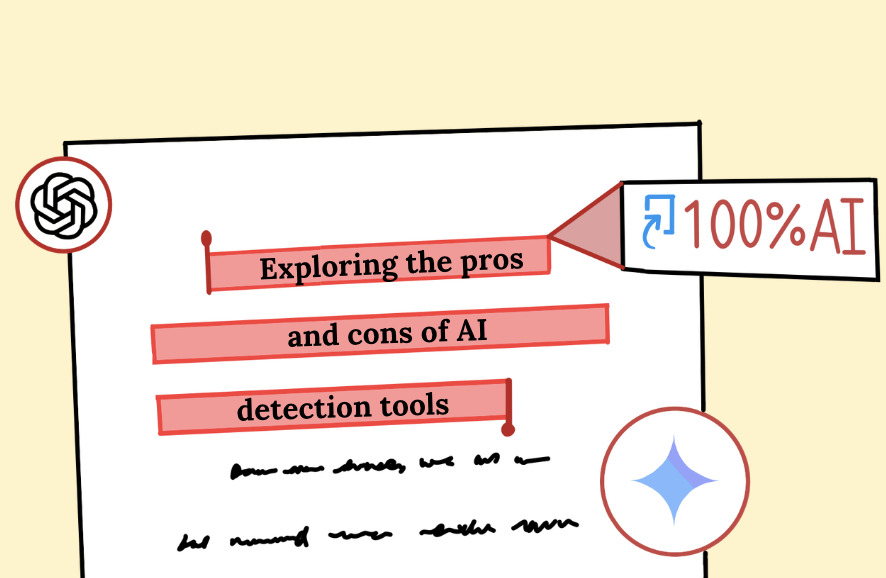
Turnitin’s AI detection analyzes students’ work by first dividing the submission into small sections of a few hundred words each — allowing the system to more easily assess the structure, language and style of the writing. The system searches for patterns present in AI-generated content, including repetitive structures or phrasing. After each section is evaluated for its percentage of AI content, an overall AI percentage is calculated.
Although the AI detection feature in Turnitin is helpful for verification, it tends to be unclear about the sections it believes are similar to generative AI — not specifying why a particular section was flagged. This ‘black box’ situation makes it more difficult to gauge whether the software is correctly analyzing student work.
“There’s an explanation, but it’s a very broad, very general explanation […] [and it] doesn’t say what was utilized. So for instance, oftentimes a report will flag for having a certain percentage of AI-produced information, [but] it doesn’t say necessarily if it came from Grammarly […] [or] if it came from ChatGPT […] [or] from something else, like QuillBot or whatnot,” Jacobs said.
Turnitin is trained to detect AI content largely by analyzing writing style. However, “humanized” AI models are now emerging that are designed specifically to bypass AI detection tools like Turnitin by adding mistakes or creating random variation in the writing to sound more human. This raises concern that Turnitin’s detection methods may gradually become outdated or less accurate.
At the moment, a primary concern for students is that AI detection tools like Turnitin have a chance of generating a false positive or marking a student’s original work as partially or fully AI-generated. As academic dishonesty can go on an individual’s permanent record, some believe it is unwise for such serious educational consequences to rely on fallible detectors.
The issue of false positives is also a concern among teachers. Said CHS Assistant Principal George Bechara, “Sometimes […] some students say, ‘No, I did not use AI,’ and then [teachers] will worry that maybe there’s a detection issue. […] Again, [AI detection tools are] not perfect, and if students are really vehemently denying it, we have other ways of figuring out if AI has been used.”
To address issues with AI detection tools, teachers may also implement alternative methods to limit or prevent AI usage. This includes using the version history function on Google Docs, watching live replays of students’ typing, making students write by hand without technology or checking if a student’s logic lines up throughout their entire writing process.
Nevertheless, these methods have their own limitations. While these alternative measures can discourage students from generating essays from scratch, they cannot reliably prevent them from using AI to polish or revise their work.
Moreover, completely avoiding AI-detection tools is not necessarily beneficial. Without those tools, teachers would have limited methods of verifying authenticity. Teachers can identify red flags like repetitive phrasing just as an AI detector would, but intuition cannot serve as solid evidence. Additionally, AI detectors can help alert teachers to unusual patterns within students’ writing that might otherwise go unnoticed.
Ultimately, it is difficult to determine with certainty whether AI detection tools like Turnitin are accurate. Given that AI usage in schools is unlikely to end anytime soon, teachers should continue to use these tools to ensure students are honest in their work. However, while AI detectors can provide a solid starting point, they are not accurate enough to be fully relied on. Teachers should incorporate alternative methods to ensure that students’ work is evaluated correctly.
“We’re here to learn,” Jacobs said. “So if you’re not learning, [then] at some point, it catches up to you. [At] some point, you do have to do something on your own, [and] I would think […] that’s going to create a problem.”