

In an era where information about public figures is always a click away, it has become increasingly easy for fans to intrude upon the lives of their favorite celebrities. What started as a “fun” way for fans to connect with stars has evolved into a dangerous obsession with real-life consequences.
The idea of “shipping”, short for relationshipping, is the act of creating romantic pairings between fictional characters or real-life people. It first became a widespread phenomenon after the release of “The X-Files” in 1993, when viewers who strongly desired a romantic pairing between the lead characters began to write fanfiction. From then on, the phenomenon of shipping culture became a way for fans to empathize with and feel connected to their favorite characters, deepening their emotional ties to the works of fiction.
For many fans, shipping and fanfiction serve as forms of emotional fulfillment, where they can project personal fantasies onto a character and enjoy exploring these daydreams in a risk-free way. In some communities, shipping is used to help readers feel accepted, especially those who identify with the LGBTQ+ community. Some members of society are not open to same-sex relationships, so fans read and write fanfiction of same-sex ships to allow them to feel more accepted.
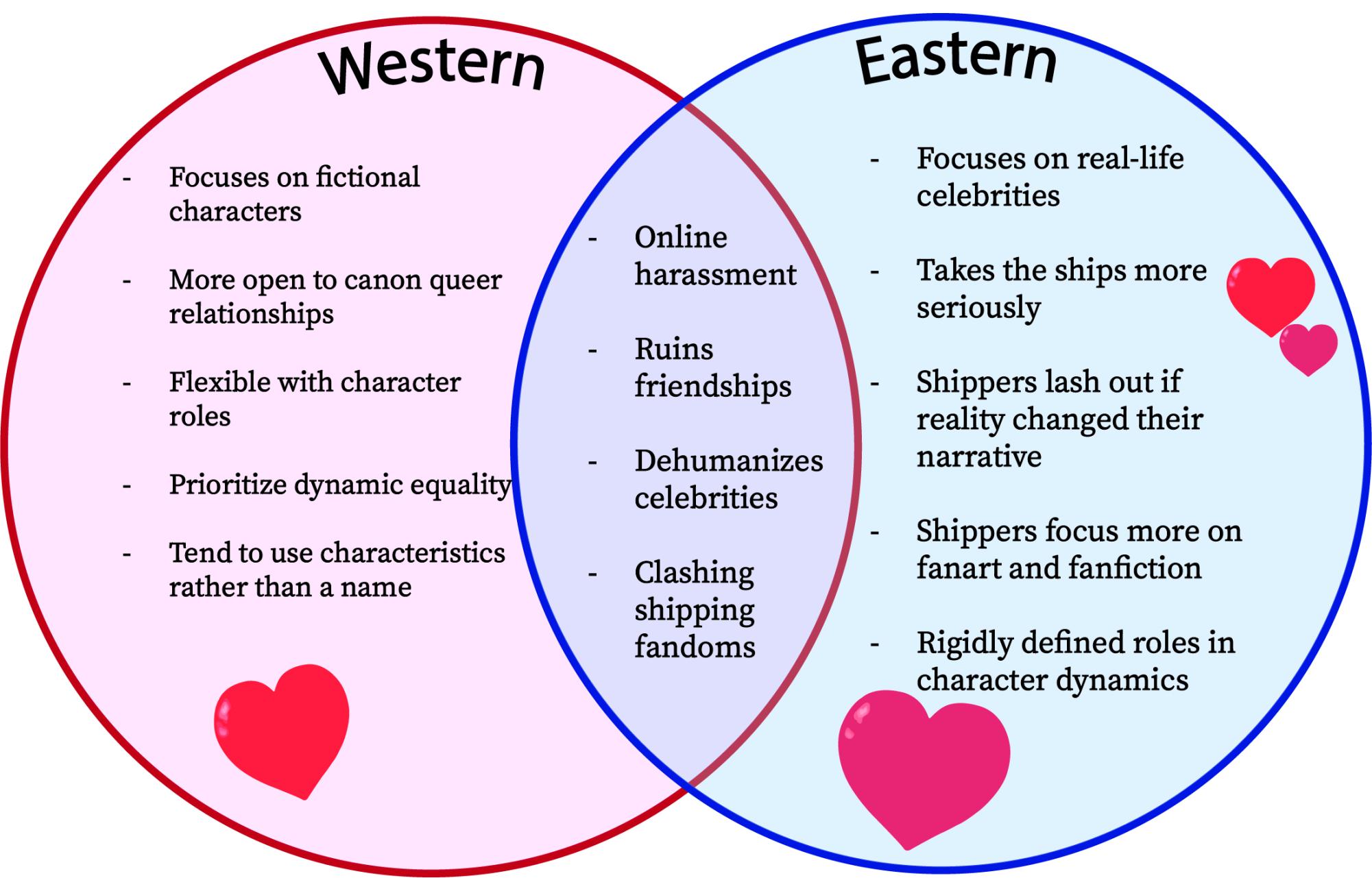
However, there is a distinct difference between the different types of shipping, particularly between Eastern and Western shipping cultures. Western fandoms tend to focus more on fictional characters, such as “Dramione”, a popular pairing from J.K. Rowling’s Harry Potter series. Eastern shippers, on the other hand, focus more on real-life figures, such as idols, actors and celebrities. Fans often take their ships more seriously and tend to move quickly from shipping characters to shipping the real-life actors. This shift from fictional characters to real people is where most significant damage occurs, as fans often struggle to separate the performer from the performance.
The consequences of taking shipping too far are frequently devastating for the celebrities involved. To find evidence that their ships are true, fans overanalyze songs, social media posts or personal details. When a celebrity pursues a romantic relationship with someone not from a popular ship, privacy violations and harassment towards the individual often follow, such as in the case of Hailey Bieber, the wife of singer Justin Bieber. Many shippers of Jelena, the ship between Justin Bieber and Selena Gomez, became convinced that Hailey Bieber had “stolen” Justin Bieber from Gomez. They harassed Hailey Bieber online, causing her to turn off the comments on her posts, harming her career as an internet personality as well as her mental health. Hailey Bieber posted about the harassment on an Instagram story. Said Hailey Bieber, “I usually stay quiet […] but it has truly gotten to a level of anger and hate that is shockingly unhealthy and sad.”
In extreme cases, fan-driven narratives can derail entire careers, such as the “227 Incident” in China. In 2020, a fan reported a fanfiction written about Chinese actor Xiao Zhan, famous for his role in the popular Boys’ Love show “The Untamed,” for being insulting to his image. This resulted in a widespread ban of Archive of Our Own, a popular fanfiction website also known as AO3, and other similar platforms. Enraged readers blamed Zhan, who had nothing to do with the ban, believing it was his fault for failing to control his fans. They began to spread hate and boycott his works and the products he promoted, leading to the loss of several endorsement deals and commercial contracts.
Zhan’s acting career also suffered, as his previous works received an onslaught of unfair negative reviews. In the end, he was forced to apologize publicly for the action of a fan. A year later, Zhan reflected on the incident in a Weibo post. Said Zhan, “The storm happened so suddenly, as though a barrel of explosives had suddenly detonated with such force that my entire being was left completely dazed.” This incident highlighted the severity of toxic fan culture and the consequences of shippers overstepping their boundaries. By pushing certain narratives, fans risk creating unnecessary rumors that potentially harm careers.
Supporters of shipping culture have argued that shipping is simply a form of creative expression, a way for fans to take public figures off pedestals and humanize them. Instead of seeing them as humans with their own agency, the opposite often happens, with shippers reducing these idols into characters manipulable by the fan’s imagination. Companies often exacerbate this behavior by encouraging “fanservice,” where they purposefully pair popular idols together to gain traction and profit. This creates a toxic cycle where the line between a public relations stunt and reality becomes blurred so that fans begin to feel entitled to meddle in a celebrity’s private life.
That being said, shipping when done respectfully is a great way for fans to feel a deeper connection to their favorite celebrity. For shipping to become a less toxic culture, fans must recognize the lines of basic respect and that shipping should remain a private fantasy rather than a public statement. This involves a conscious effort to respect the personal boundaries of those who did not consent to being part of a narrative. Fans also need to learn to recognize “fanservice,” as many romance rumors are carefully curated actions by companies to gain their groups more traction. Even when a relationship is officially confirmed, celebrities should not have to face harassment because the reality did not match a fan’s expectations.
At the end of the day, shipping is not inherently problematic, but the extent to which fans are willing to inflict harm for the sake of an imagined pairing is a pressing issue. These public figures are real human beings, not fictional characters, and deserve the right to choose with whom they wish to pursue a romantic relationship.