


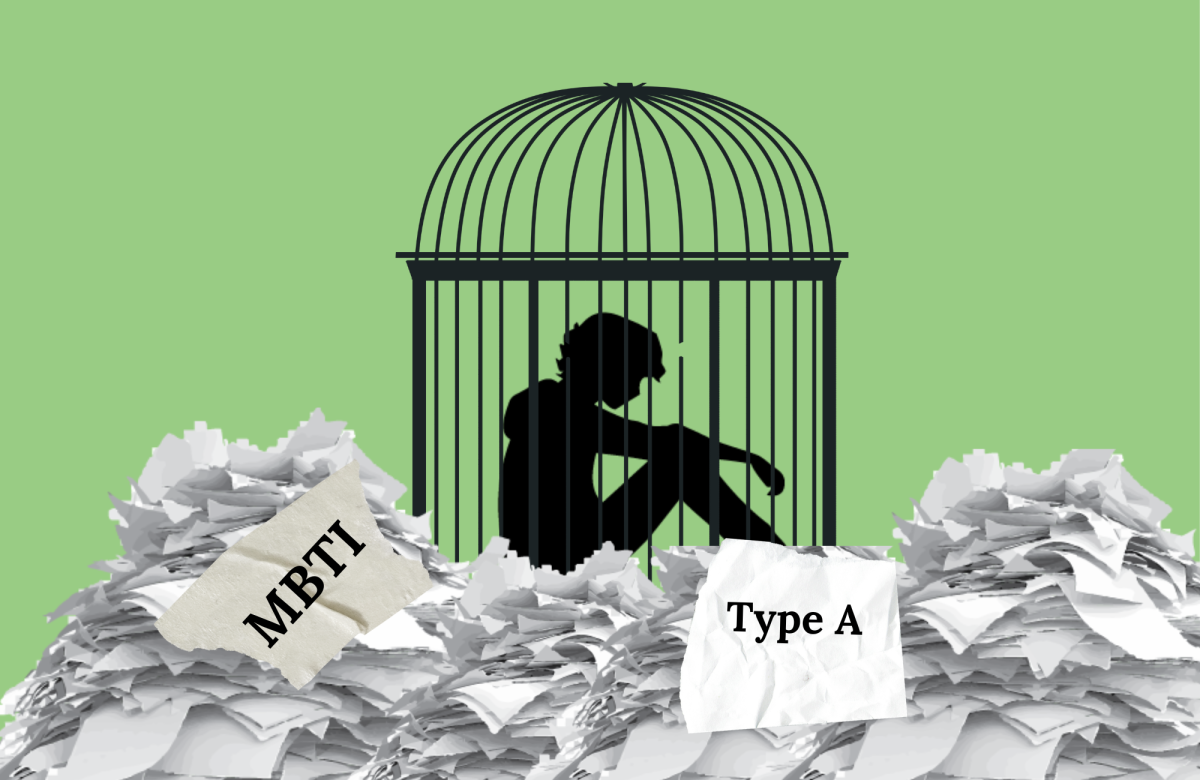
In an age where online quizzes and algorithms define personalities, people are increasingly tempted to rely on labels to simplify their identity. This confines people to a specific personality, encouraging them to conform to a version of themselves that may not accurately reflect who they are.
Personality tests are designed to measure aspects of personality and analyze behavioral traits. Often used for career guidance and self-insight, these tests measure human behaviors, preferences, attitudes and characteristics. The most commonly used personality tests are the Myers-Briggs Type Indicator, the Enneagram and the Big Five. The MBTI test consists of 16 personality types using dichotomies. These include Introversion, Intuition, Feeling and Prospecting represented by the letters “INFP”, or Extroversion, Sensing, Thinking and Judging represented by “ESTJ.” The Enneagram consists of nine personality types, which are described with labels such as “the reformer” or “the achiever.” Finally, the Big Five was developed to understand the correlation between personality and outcomes such as academic success and career paths. Its five dimensions are Neuroticism, Extraversion, Openness to Experience, Conscientiousness and Agreeableness. The most widely used test is the MBTI test, due to its simplicity and accessible framework of 16 distinct personality types. It is also practical in external aspects of life, such as work and communication, whereas the other tests reflect an individual’s internal systems and motivations.
Personality tests appeal to people by providing a clear framework that helps them understand their strengths, weaknesses and behaviors. It serves as a tool to validate one’s own self-image, providing deeper insight and thorough self-understanding. Additionally, people often hope personality tests will reveal something about their character that was previously unknown.
One effect of this pattern is the Barnum effect. It is a common cognitive bias where individuals believe that vague personality traits apply specifically to them, altering broad statements and surface-level analyses into personal views of themselves. As noted by the Elton B. Stephens Company, an online academic library, this is believed to be due to the bias of preferring to see oneself in a good light and trusting external sources’ comments regarding themselves. The Barnum effect influences online personality tests, particularly the MBTI, because descriptions of the 16 types are generally positive and broad enough to apply to many individuals, creating a false “accurate depiction” of a test taker’s personality.
Beyond hindering personal growth, when applied to the systems of wider society, dependency on online personality assessments can have major consequences. For instance, personality tests have become prominent in the social lives of younger generations in East Asia. A 2021 survey by The Korea Times revealed that in Korea, 90% of people aged 19 to 28 have taken the MBTI test. Even at Cupertino High School, some teachers take students’ MBTIs into account when teaching, as exemplified by business teacher Aiden Hill’s seating arrangement technique, in which he groups students based on their MBTI results. Furthermore, as tests become increasingly popular, many businesses have begun incorporating personality testing into their hiring processes and shaping workplace environments based on established “types.”
The popularity of personality testing is especially concerning since the tests have evolved from self-reflection to cultural identifiers. Per the Beijing Review, in China, when young individuals are first introduced to each other, they choose whether to deepen their connection based on MBTI compatibility rather than common experiences or interests. Although this may form relationships of greater mutual harmony and trust, it can lead to like-minded relationships, sacrificing the opportunity for personal growth in communication.
“While dating someone who has similar personality preferences can have its benefits, we have all heard of the expression ‘opposites attract,’” said Cameron Nott, a psychologist on CNN. “To rule out a potential partner on account of having a different MBTI personality type might see someone miss out on an exciting relationship with a wonderful person.”
Moreover, personality typing has also influenced the hiring process. According to The American Psychological Association’s “Speaking of Psychology” podcast, nearly 80% of human resource professionals require some form of testing from job candidates for employment decisions. Dr. Fred Oswald, an expert in workplace psychology, emphasizes that effective assessments must be reliable, valid and fair. Personality tests struggle to meet these essential requirements, as the assessments are biased towards the test-taker’s perceptions of themselves, limiting tangible evidence. According to an article by the New York Times, the vagueness of the tests provides little correlation to workplace performance, as personal characteristics rarely impact one’s ability.
Said Dr. Sarah Gaither, a professor of psychology at Duke University, “When thinking about different assessments, race/ethnicity, gender, region, socioeconomic status and disability can all impact not only how someone interprets a question when taking a given assessment, but they can also color how someone interprets a score.”
These conditions subject the tests to error, opening the door to unreliable decisions that influence the course of an individual’s life. Besides a candidate’s internal bias, hiring managers also harbor prejudice in choosing applicants, preferring individuals with personality types that “fit” a company’s social landscape over capability. As stated by Sixth Tone, a Chinese online culture magazine, certain MBTIs are considered more tame and easier to manage, prompting recruiters to reject applicants with stronger personalities.
This may lead individuals to alter their own personalities to conform to societal standards. In a New York Times article, writer Quinisha Jackson-Wright expresses the strain of conforming to a more extroverted working style, facing repercussions for her preference for isolation as an introvert. Ultimately, when personality assessments are used for wide-scale hiring decisions, they risk classifying candidates as “unqualified” due to the corresponding traits of their results, creating disparity in economic opportunity.
Excessively identifying with online personality types can stunt self-development, and the adoption of these labels in societal frameworks may restrict individuals’ social and economic prospects. What seems like a fun quiz can have harmful real-world outcomes, and in a society that increasingly relies on data and categorization, flawed personality testing can misinform significant decisions. Ultimately, while lighthearted use of personality tests is fun and inconsequential, it is vital that people never assign true meaning to personality typing.





Niranjan • Apr 4, 2026 at 8:52 pm
I believe Goodhart’s Law deserves a mention: its essence is that when a metric is made the target, then the quality of the metric degrades. (This essentially stems from (a) minor flaws in the metric are now much more important than before, if they’re being used for, say, hiring and (b) the fervent job-seeker will try to tweak their test results by optimizing their responses, leading to the test being a less “true” measure of personality.) In this context, MBTI tests being used in professional settings is an example of this: it’s being assigned weight in decisions, making it a target for prospective candidates rather than the metric it was designed to be.
A related idea is the distinction between correlation and causation. Whereas a test may be observed to be correlated with certain life outcomes, it’s extremely difficult to establish causation here (as this would require an experiment to be designed, in which people are “assigned” personalities). So, is the use of MBTI in life decision valid in any capacity?