

Seven minutes. Four thieves. Nine pieces of priceless jewelry. On Oct. 19, 2025, criminals dressed as construction workers executed the swiftest and most expensive heist in the history of France’s Louvre Museum.
The thieves accessed a second-story window via a furniture lift and used angle grinders to break into the Apollo Gallery. They stole nine pieces of the French Crown Jewels — one of which, a crown belonging to Empress Eugiénie, was recovered broken outside the museum — before fleeing on motorbikes.
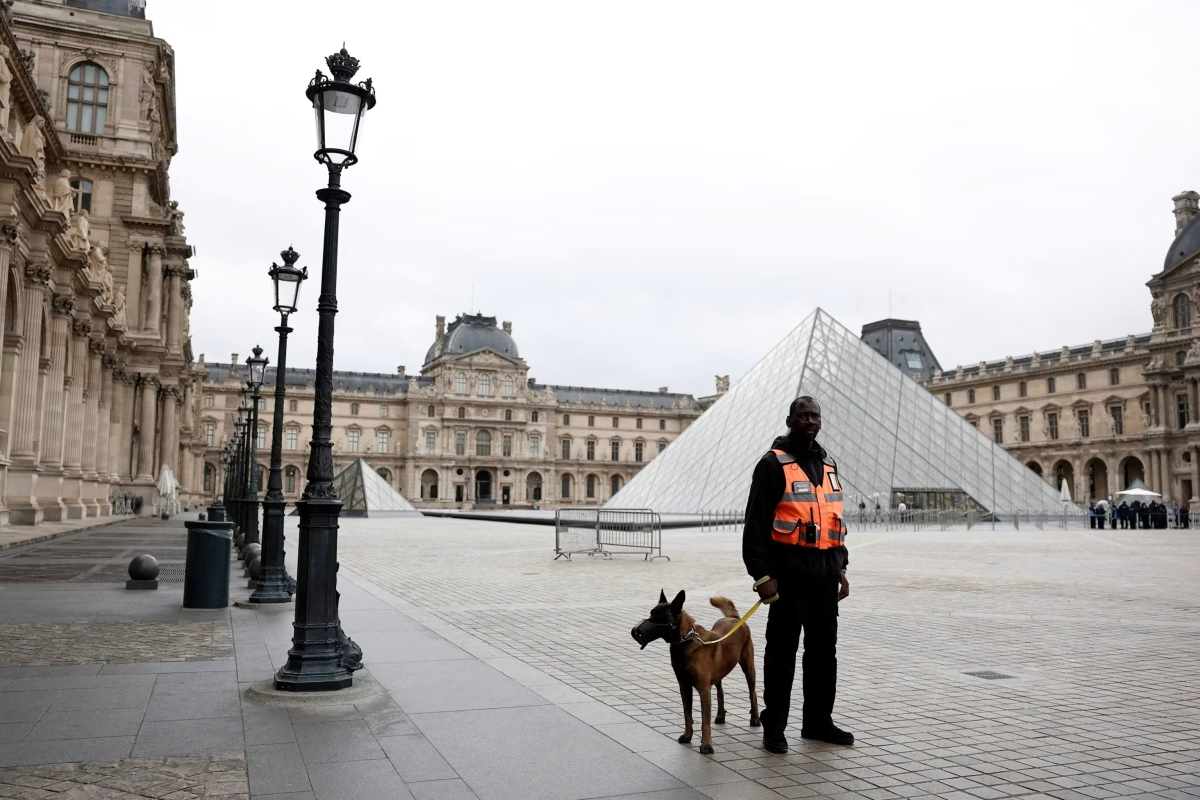
The stolen jewelry was valued at $102 million, but the damage was more than financial — not only did it prompt public criticism of the Louvre’s security measures, it also exposed a pattern of vulnerability and increasingly effective methods of theft. Members of the French public accused the museum of favoring projects that were visible and attractive at the expense of protection. The Louvre’s Nouvelle Renaissance project, launched earlier this year, included a large-scale renovation of the museum’s main entrance, costing around $800 million.
While early Louvre heists were largely driven by nationalism or opportunism, recent robberies reveal a shift toward efficient extraction of precious materials. Modern thieves have begun to choose targets not based on cultural significance, but on practicality and financial returns — selecting pieces that are difficult to identify and can be deconstructed for valuable materials. There are networks dedicated to extracting items from museums and selling them on black markets, or dismantling them and selling them discreetly. While renowned historical artworks are easily identifiable and make for risky transactions, jewelry and other artifacts are virtually unrecoverable once reduced to their raw parts. Furthermore, the use of industrial tools to access secured areas has become more commonplace, forcing cultural institutions like the Louvre to reevaluate their security systems.
While the 2025 heist shocked the public, the Louvre is no stranger to robberies in broad daylight. On Aug. 21, 1911, Italian immigrant Vincenso Peruggia stole Leonardo da Vinci’s Mona Lisa straight off its frame, intending to return the artwork to its country of origin. The former Louvre employee hid in a closet overnight, entered the gallery while it was still closed and smuggled the artwork out of the gallery. News of the disappearance made the artwork an international sensation. The painting was recovered two years after the theft, after Peruggia attempted to sell the painting to an Italian art dealer, who alerted local authorities. Peruggia cited nationalism rather than profit as his primary motive, claiming he intended to return the painting to its native Italy.
More than a century later, the theft of Mona Lisa remains one of the greatest art heists in history. The heist made the Mona Lisa a public spectacle, launching art lovers and critics from across the world into speculation about the piece. Said novelist Dianna Hales, “The Mona Lisa had left the Louvre a work of art […] She returned as public property, the first mass art icon.”
The Louvre was subjected to a number of smaller-scale robberies as well. When Germany invaded France during World War II, the Louvre and its treasures were under threat, prompting an underground operation to evacuate precious artworks. Curator Jacques Jaujard coordinated a large-scale effort to move pieces to secure locations across France, leaving the museum virtually empty. Germany’s systematic plundering of European art collections yielded few important works from the Louvre, and the evacuated pieces were eventually reinstalled. Although no heist technically occurred, the event underscored the museum’s vulnerability and the importance of protecting its pieces from outside threats.
In the decades following the war, theft at the Louvre was exacerbated. On May 10, 1966, thieves stole five pieces of gold and ruby jewelry at John F. Kennedy Airport in New York City. The jewels belonged to the Louvre but were on loan to a museum in Virginia. The chief curator intended to increase public access to France’s prized collections. Two months later, police intercepted the jewelry in a grocery bag as it was being sold. Three suspects were arrested in connection with the sale. This showed the French public that non-museum entities did not adhere to the same standards of care as expected.
Years later, on Dec. 16, 1976, three masked burglars climbed a scaffolding set up outside the museum and stole a diamond-studded sword used for the 1824 coronation of King Charles X. The sword was housed in the same gallery from which the French Crown Jewels were recently stolen. The Louvre’s automatic alarm system prevented the thieves from seeking out other pieces, but they left the way they entered. The sword was never recovered, and the burglars were not officially identified. This incident has been used in the present day to criticize the museum’s weak perimeters.
The museum continued to suffer lapses in security in subsequent years. On May 31, 1983, two pieces of Italian Renaissance armor went missing from the museum — a ceremonial helmet and a breastplate. The theft remained an unsolved mystery until both items were identified in the private collection of a family in Bordeaux, France. However, events leading up to the theft remain an enigma, with few details known to the general public.
Another high-profile incident followed on July 7, 1990, when thieves cut a small painting — Pierre Auguste Renoir’s “Portrait of a Seated Woman” — in broad daylight from a third-floor balcony. The museum was shut down for hours, and the French police conducted body searches on hundreds of visitors. An inventory ordered after the theft revealed that a dozen pieces of ancient Roman jewelry were also stolen from the museum. The police investigation did not turn up promising leads, and none of the stolen items were found.
The theft of Jean-Baptiste-Camille Corot’s “Le Chemin de Sèvres” on May 3, 1998, marked the most recent Louvre robbery before the 2025 heist. The perpetrator pried open the painting’s glass case and cut it from its frame during visiting hours. Despite a museum lockdown and thorough bag checks on visitors, the piece was never recovered. While the robbery prompted a museum security overhaul, this ultimately failed to prevent future heists.
From the theft of the Mona Lisa in 1911 to the heist of the French Crown Jewels in 2025, the Louvre’s extensive history of theft has played a crucial role in the museum’s development. A century later, the lesson from history remains the same: as forms of museum robbery evolve, so should the Louvre’s approach to modernized security.