


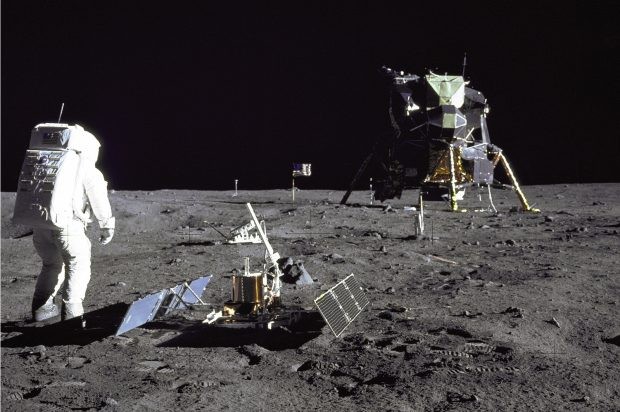
On May 25, 1961, President John F. Kennedy declared that the United States would land a man on the moon. Eight years later, on July 20, 1969, Neil Armstrong became the first human to set foot on the lunar surface. Now, NASA is ending its half-century hiatus to turn the moon into a permanent home.
The mission to reach the moon began with the Space Race, as a result of the Cold War between the United States and the Soviet Union. In 1957, the Soviet Union launched Sputnik 1, the first artificial satellite, sparking an 18-year technological competition. Aiming to reassert technological dominance, Kennedy challenged the nation to land a man on the moon before 1970 — marking the beginning of America’s decade-long lunar exploration and the fight
Eager to fulfill the challenge, NASA launched its Apollo program later that year, aiming to create technology capable of exploration and research in the lunar environment. More importantly, they hoped to beat the Soviet Union to the lunar surface. After several tests, Apollo 8 became the first human mission to see the far side of the moon, famously capturing the “Earthrise” photograph.
Following Apollo 8’s successful splashdown on Dec. 27, 1968, renewed hope and anticipation from the American public fueled the program to continue testing. On July 20, 1969, Apollo 11 successfully delivered the first humans onto the lunar surface. Commander Neil Armstrong and lunar module pilot Edwin “Buzz” Aldrin landed the Lunar Module Eagle, while command module pilot Michael Collins remained in orbit. At 2:56 UTC, Armstrong became the first person to set foot on the lunar surface with the famous words, “That’s one small step for [a] man, one giant leap for mankind.”Armstrong and Aldrin spent a total of 2 hours and 31 minutes on the moon, collecting 21.9 kilograms of lunar rock samples that revealed the moon’s volcanic history and provided evidence for the giant impact hypothesis.
After performing ceremonial tasks like planting the U.S. flag and unveiling a plaque on the lunar module, Armstrong and Aldrin reunited with Collins on the spacecraft. Blasting off on July 16, Apollo 11 had spent 2.5 days in lunar orbit before splashing down on July 24, 1969. Apollo 11 was the first crewed lunar landing in the history of space missions, but it was certainly not the last — its success only drove NASA to send more astronauts into space. However, this era of great scientific advancement was not without its roadblocks.
Apollo 13, the seventh crewed mission in the Apollo program, was intended to be the third moon landing following the successes of Apollo 11 and 12. On April 13, Commander Jim Lovell reported to Mission Control Center with the infamous words, “Houston, we’ve had a problem.” One of the oxygen tanks had exploded and was actively leaking oxygen gas from the spacecraft. In a desperate attempt to conserve power, the crew — Jim Lovell, Jack Swigert, and Fred Haise — were forced to use the lunar module as a lifeboat. Rounding the moon, the crew disappeared for roughly 20 minutes before propelling back to Earth, the farthest distance from Earth reached by humans. Finally, on April 17, the lunar module was jettisoned, and the crew splashed down safely on Earth, but not without physical damage from a lack of food and dehydration.
On the night of Dec. 6, Apollo 17, the final lunar mission, blasted off, becoming the only night launch in Apollo history. The crew spent a total of 75 hours on the moon, the longest of any Apollo mission, and Commander Eugene Cernan remains the last person to walk on the moon. With that, Apollo 17 marks the end of an era.
Although there were originally 20 missions planned, the program ended at 17. After Apollo 11’s successful landing, public support began to waver as more pressing issues demanded attention and funds. With an estimated total cost of $20 billion amid international struggles like the Vietnam War, NASA faced major funding cuts as the government prioritized education and anti-poverty programs over space exploration. At its core, Apollo 11 was a political statement, and once the U.S. had proved its technological superiority, its political urgency faded along with America’s desire for the moon.
Now, half a century later, NASA is once again exploring the possibility of landing a human on the moon. This time, NASA hopes to make groundbreaking scientific discoveries, to reignite America’s passion for exploration and to inspire a future generation of engineers and scientists. Their goal is to go to the moon and stay there by establishing bases in lunar orbit and on the moon’s surface. Since humans can collect large numbers of lunar rock samples much faster than robots, scientists hope this mission will further their understanding of lunar geology and ice. Most importantly, these lunar missions will serve as stepping stones for the greater goal of settling on Mars.
On Nov. 16, 2022, NASA launched Artemis 1, the first of the Artemis program. This uncrewed flight orbited 130 kilometers above the lunar surface for 25 days. This mission was mainly to ensure that systems for communication and on the Orion spacecraft were suitable to fly astronauts to the moon and back. In this test flight, Artemis 1 broke the historic record set by Apollo 13 for the farthest distance traveled by a spacecraft designed to carry humans into space and back.
The second phase of the Artemis Project, Artemis 2, is set to launch no later than April 2026 and will be in orbit for around 10 days. This will be the first crewed lunar flyby since 1972, meaning the spacecraft will not land on the moon. This mission is simply to confirm that all systems operate as designed in an actual environment and that the spacecraft can be operated by the four crew members. Although the flight date has been repeatedly postponed from its original launch date of September 2024, NASA aims to finish all dress rehearsals by the end of January.
Scheduled for 2028, Artemis 3 plans to mark humanity’s return to the lunar surface after more than half a century. This mission will mark several historic firsts, including the first woman and first person of color to walk on the moon, as well as the first humans to explore the lunar South Pole. These astronauts will spend a week living and exploring the lunar surface, sampling water ice and retrieving lunar rocks.
The Apollo era proved we could reach the stars, and now, Artemis hopes to prove that we can live among them. What began as a high-stakes political statement amid a tense war has evolved into a mission of permanent residency. With new research and renewed interest in space, NASA expects to bring a new era of lunar exploration and discovery to the forefront of our technological revolution.