

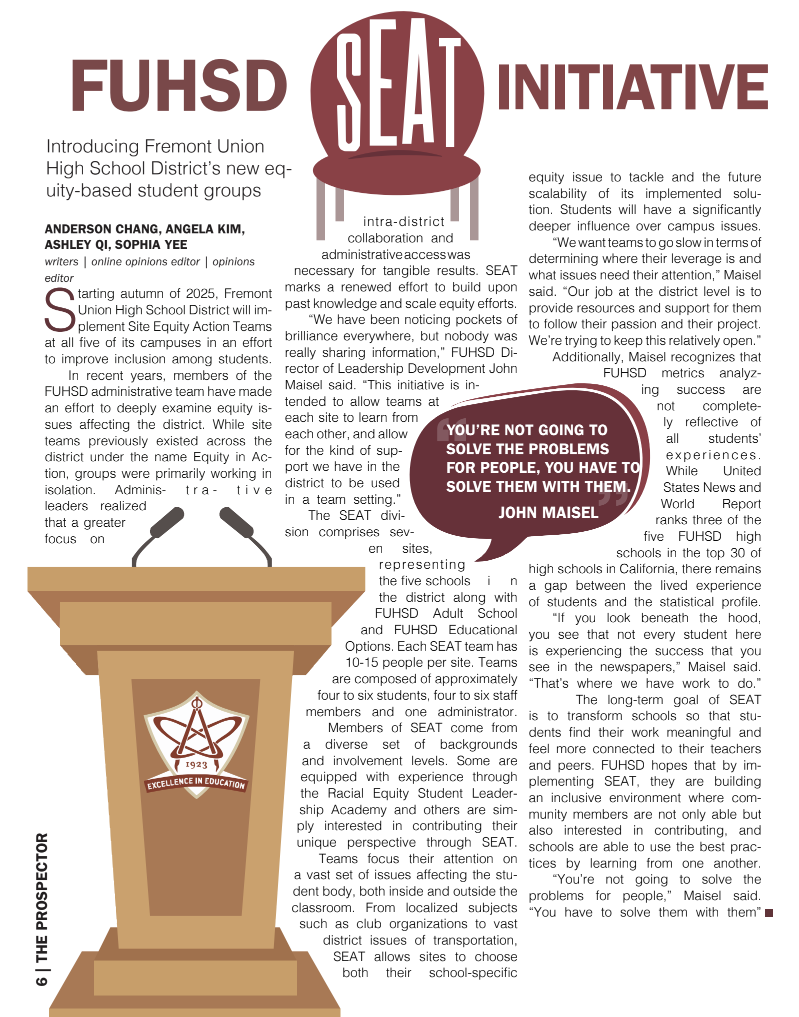
Starting autumn of 2025, Fremont Union High School District will implement Site Equity Action Teams at all five of its campuses in an effort to improve inclusion among students.
In recent years, members of the FUHSD administrative team have made an effort to deeply examine equity issues affecting the district. While site teams previously existed across the district under the name Equity in Action, groups were primarily working in isolation. Administrative leaders realized that a greater focus on intra-district collaboration and administrative access was necessary for tangible results. SEAT marks a renewed effort to build upon past knowledge and scale equity efforts.
“We have been noticing pockets of brilliance everywhere, but nobody was really sharing information,” said FUHSD Director of Leadership Development John Maisel. “This initiative is intended to allow teams at each site to learn from each other, and allow for the kind of support we have in the district to be used in a team setting.”
The SEAT division comprises seven sites, representing the five schools in the district along with FUHSD Adult School and FUHSD Educational Options. Each SEAT team has 10-15 people per site. Teams are composed of approximately four to six students, four to six staff members and one administrator. Students get involved with SEAT through a combination of open interest and targeted invitation. Members come from a diverse set of backgrounds and involvement levels. Some are equipped with experience through the Racial Equity Student Leadership Academy, or RESLA, and others are simply interested in contributing their unique perspective through SEAT.
Teams focus their attention on a vast set of issues affecting the student body, both inside and outside the classroom. From localized subjects such as club organizations to vast district issues of transportation, SEAT allows sites to choose both their school-specific equity issue to tackle and the future scalability of its implemented solution. Students will have a significantly deeper influence over campus issues.
“We want teams to go slow in terms of determining where their leverage is and what issues need their attention. Our job at the district level is to provide resources and support for them to follow their passion and their project. We’re trying to keep this relatively open,” Maisel said.
Additionally, Maisel recognizes that FUHSD metrics analyzing success are not completely reflective of all students’ experiences. While United States News and World Report ranks three of the five FUHSD high schools in the top 30 of high schools in California, there remains a gap between the lived experience of students and the statistical profile.
“If you look beneath the hood, you see that not every student here is experiencing the success that you see in the newspapers. That’s where we have work to do,” Maisel said.
SEAT’s goal is to connect all previously isolated equity efforts with the district’s equity resources and training. Site-based teams will learn from each other, sustain long-term projects and ensure students feel a sense of belonging.
FUHSD’s 2025-2026 Local Control and Accountability Plan, or LCAP, illustrates how SEAT is meant to provide students with a platform for direct engagement.
“Among these priorities are the inclusion of students in rooms where leaders are making decisions that impact their experience,” states the document. “So, rather than students providing input on advisory lessons … the students participating in SEAT will have much more direct knowledge of and influence over how the school prioritizes issues around student health, belonging, and engagement.”
The long-term goal of SEAT is to transform schools so that students find their work meaningful and feel more connected to their teachers and peers. FUHSD hopes that by implementing SEAT, they are building an inclusive environment where community members are not only able but also interested in contributing, and schools are able to use the best practices by learning from one another.
“You’re not going to solve the problems for people,” Maisel said. “You have to solve them with them.”