


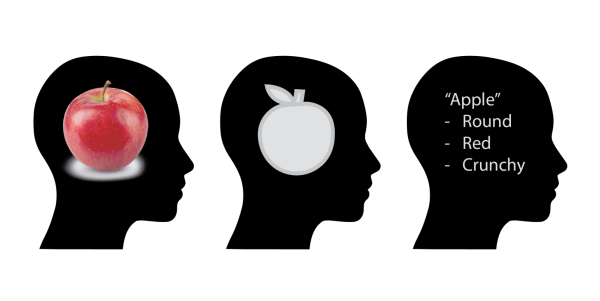
Close your eyes and imagine an apple. What do you see? Some people can conjure up a vivid and realistic mental image of an apple, while others only imagine a vague outline or shape. For some, there is no picture at all, and they can only think of an apple by recalling a list of its characteristics — using words, not imagery. What you picture reveals whether you tend to think in words, images or a mix of both, and where you fall on the spectrum of visual and verbal thinking.
Those who think in words likely have what is called an “internal monologue,” or a voice inside one’s head that verbally narrates a person’s thoughts. Studies vary in terms of what proportion of the population has an inner voice. Research by psychologist Russell Hurlburt, a professor of psychology at the University of Nevada, suggests that anywhere between 30% to 50% of the population falls in this category, while other studies point toward figures closer to 25%. In a poll distributed through The Prospector’s social media, 102 of 127 responders, or 80.3%, reported having an internal monologue.
Even among verbal thinkers, not all individuals process information in the exact same way. Rather than a binary of visual versus verbal thinking, cognitive function exists on a spectrum — one in which most people are left somewhere in between the two categories.
For individuals who fall in between, the extent to which they can vividly visualize imagery is a key determining factor in their cognitive processing. People vary drastically in their ability to conjure images — some are capable of producing highly detailed imagery, while others are unable to visualize at all. Individuals who are entirely unable to think visually likely have a cognitive trait known as aphantasia. The lack of mental imagery has a profound impact on individuals’ daily lives. Research conducted in 2023 in the journal Cortex found that aphantasiacs have weaker facial recognition than people with visual imagery skills, meaning that they are less able to remember or create mental images of others’ faces. On the other hand, individuals with hyperphantasia see objects, experiences and memories with lifelike detail. Hyperphantasiacs often have exceptional visual memory and can experience stronger emotional experiences connected to what they see.
Bridging hyperphantasia and aphantasia is hypophantasia, or the ability to imagine brief, fleeting visuals. While a portion of verbal thinkers experience a constant stream of internal narration, some only occasionally experience an inner voice, and others only when prompted. For a majority of individuals, mental imagery accompanies verbal thought. The two coexist to form one’s thinking process — a blend unique to each person. Seventy-one of 127 poll responders, or 55.9%, identified as having both visual and verbal cognitive processes.
Those who lack an internal monologue are likely visual thinkers. They tend to process information through images and patterns while learning, recalling memories or solving problems. For example, visual thinkers might picture layouts before creating a model or imagine routes when navigating. Visual thinking can be categorized into two groups: object visualization and spatial visualization. Object visualization allows one to see detailed, vivid mental images, while spatial visualization focuses on locations, movement and patterns. That being said, being a visual thinker does not necessarily equate to having hyperphantasia — similar to how verbal thinkers vary in the intensity of their internal monologues, visual thinkers vary in their ability to visualize intense, vivid imagery. Of 127 poll responders, 93 reported thinking in visual images, or about 73.2%.
There is no singular formula that dictates a person’s specific cognitive style. Whether one is a verbal or visual thinker is determined by a wide variety of factors, including genetics, childhood experiences, language development and environment. Cognitive scientists theorize that one’s thinking process is likely a combination of innate and learned traits, with both natural preferences and early environments contributing to a broader internal landscape.
Knowing one’s thinking style can offer better insight when choosing hobbies, learning styles and future professions. Verbal thinkers often succeed as lawyers or journalists, while visual thinkers may excel as artists, architects and engineers. Even so, these categories are not mutually exclusive, as most people exist on a spectrum between visual and verbal thinking and possess skills from both. Additionally, these generalizations should be considered guidelines rather than defining labels. Being an aphantasiac, for example, does not mean that one cannot pursue creative roles such as an artist or designer — Disney animator Glen Keane and Pixar co-founder Ed Catmull both have aphantasia. Individuals can find success and fulfillment in any field of work, whether or not it fits into common stereotypes.
Ultimately, reflecting upon one’s own thinking style is a powerful tool for self-understanding — offering crucial insight into how people’s inner worlds shape the way they process the information, memories and experiences that surround them.